Inventing Room
Charlie and the Chocolate FactoryThe Inventing Room is the most secretive and technologically extravagant laboratory in Wonka's Chocolate Factory. Hidden behind a red door marked “INVENTING ROOM — PRIVATE — KEEP OUT,” it is presented by Willy Wonka as the factory’s most important room: a restricted workspace where new sweets are “cooking and simmering,” and where commercial invention becomes a form of theatrical magic. The room’s products promise extraordinary benefits, but their unfinished states also expose the risks concealed beneath Wonka’s confident showmanship.
Entrance and Exclusive Status
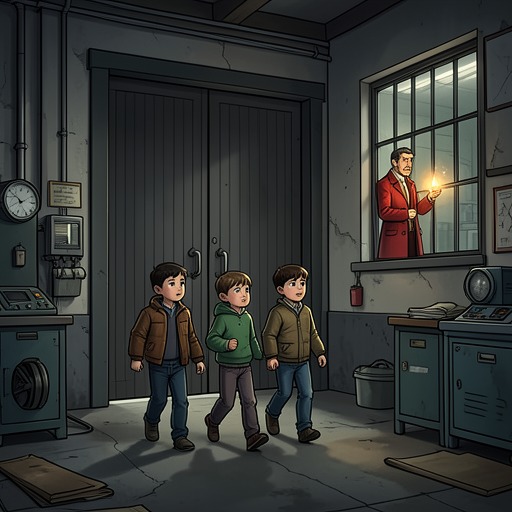
The Inventing Room is reached during the boat journey along the Chocolate River. When Willy Wonka sees the bright red door, he orders the Oompa-Loompas to stop the boat; they jam their oars into the river and back water furiously until the boat comes alongside. Wonka then takes a key from his pocket and unlocks the door, making physical access depend on his personal authority. The warning “PRIVATE — KEEP OUT” establishes the room as a forbidden interior rather than an ordinary factory department.
Wonka emphasizes that even the other chocolate makers would pay heavily for a glimpse of what lies inside. He names Fickelgruber, Prodnose, and Slugworth as rivals who would give their front teeth to enter for three minutes. He also states that nobody else, “not even an Oompa-Loompa,” has previously been admitted. The visitors therefore enter not merely a workplace but a protected vault of industrial knowledge. Wonka permits the children and their parents to follow him only after issuing strict rules: no touching, meddling, tasting, or knocking anything over.
A Laboratory of Mechanical Abundance
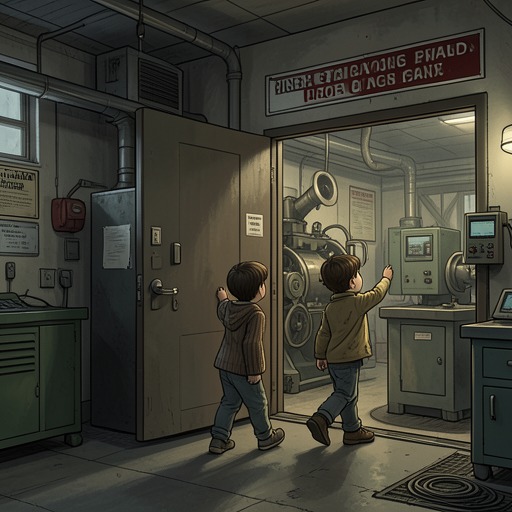
Inside, the Inventing Room resembles a witch’s kitchen enlarged to an industrial scale. Black metal pots boil and bubble on huge stoves; kettles hiss, pans sizzle, and strange iron machines clank and splutter. Pipes cover the ceiling and walls, while smoke, steam, and rich confectionery smells fill the space. The room joins domestic cooking imagery to factory production, making invention appear simultaneously homely, dangerous, and immense.
The machinery is active rather than decorative. Willy Wonka moves among saucepans, barrels, ovens, and controls, lifting lids, sampling a sticky yellow substance, adjusting knobs, and peering through the glass door of a gigantic oven. A small shiny machine repeatedly makes a “phut-phut-phut-phut-phut” sound and drops a large green object into a basket after each burst; although it looks like a marble, it is the product of an experiment. The room’s constant motion gives material form to Wonka’s restless inventiveness and makes the factory’s wonders depend on processes that the visitors are not allowed to understand or interrupt.
Wonka is visibly more excited here than elsewhere in the factory, hopping between the machines as if surrounded by Christmas presents. His delight identifies the Inventing Room as the place most closely aligned with his personality. The factory’s public marvels may be designed for customers, but this room is where his private pleasure in testing, altering, and imagining new possibilities is most intense.
Everlasting Gobstoppers
One of the room’s principal inventions is the Everlasting Gobstopper. Wonka proudly explains that it is intended for children who receive very little pocket money: a child can suck it repeatedly without making it smaller. Unlike gum, it is not meant to be chewed; chewing one could break a child’s teeth. The promise of endless duration turns a small sweet into an economical object, offering lasting pleasure without requiring repeated purchases.
The claim is not entirely secured by completed knowledge. Wonka says that the Gobstoppers never get smaller and never disappear, then qualifies the assertion by admitting that he does not think they do. Their durability is still being tested in the neighboring Testing Room, where an Oompa-Loompa has been sucking one for nearly a year and it remains as good as ever. The invention is therefore both a miracle and an ongoing experiment: its apparent certainty rests on a test that has not yet reached a final scientific conclusion.
Violet Beauregarde compares the sweet to gum, but Wonka sharply rejects the comparison. The distinction separates chewing from sucking and also illustrates his insistence that his inventions create new categories rather than merely imitate familiar products. The Everlasting Gobstopper is not simply another confection; it is a challenge to ordinary assumptions about consumption, disappearance, and value.
Hair Toffee and the Limits of Control
Wonka’s second featured invention is Hair Toffee, a thick purplish mixture boiling in a large saucepan. A small portion is supposed to make a new crop of thick, silky hair grow over the eater’s head after exactly half an hour, along with a moustache and beard. The product promises to eliminate baldness, but its intended effect is already entangled with an unwanted transformation: the same recipe that restores hair also produces facial hair.
The mixture is not ready for use. Wonka admits that it is too strong and works too well. When he tested it on an Oompa-Loompa the previous day, a huge black beard began shooting from the subject’s chin and grew into a thick, floor-covering carpet faster than it could be cut. The workers eventually had to use a lawn mower to keep it under control. This episode makes the laboratory’s comic extravagance inseparable from failed regulation: the invention achieves its purpose so violently that ordinary tools cannot contain it.
Wonka nevertheless expects to correct the formula. His confidence reflects the room’s governing principle: an imperfect experiment is not abandoned but adjusted until it can become a product. The contrast between the promise of freedom from baldness and the image of hair spreading across the floor gives Hair Toffee an unsettling double edge. It embodies the factory’s power to improve the body while also showing how easily that power can exceed its maker’s intentions.
The Room’s Larger Significance
The Inventing Room concentrates the book’s recurring tension between wonder, commerce, and risk. Its inventions are designed for practical consumer problems, such as limited pocket money or baldness, yet they are developed through secret procedures, prolonged testing, and spectacular accidents. Wonka’s laboratory thus presents innovation as neither pure magic nor ordinary manufacture. It is a controlled performance whose control is repeatedly shown to be provisional.
The room also clarifies how Wonka’s factory protects its brand. The Golden Ticket contest promises that five children will see the factory’s secrets, but even this extraordinary tour does not erase boundaries: the Inventing Room remains private, and visitors are admitted only under Wonka’s supervision. The wider contest has already created a worldwide frenzy of chocolate buying, while Wonka’s inventions remain hidden behind locked doors. Public excitement and private secrecy work together, turning restricted knowledge into commercial fascination.
Most importantly, the Inventing Room is a miniature of Wonka himself. He is generous enough to display remarkable creations, theatrical enough to turn every machine into a spectacle, and possessive enough to guard his inventions from rivals and careless guests. The room’s bubbling pots, hissing pipes, and unfinished formulas give physical shape to an imagination that is brilliantly productive but never entirely safe. It is the factory’s creative center precisely because it makes visible both the promise of impossible sweets and the consequences of experimenting beyond familiar limits.